

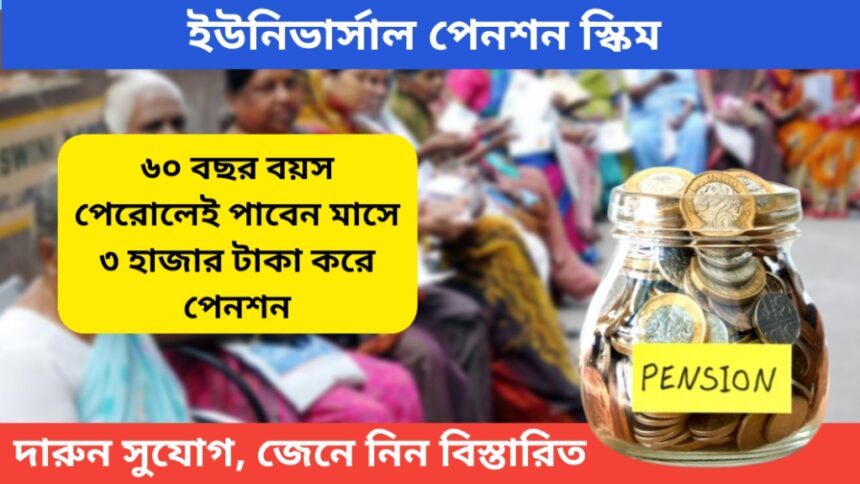
The Government of India has taken an initiative to introduce a financial plan called the Universal Pension Scheme. This scheme of the Central Government is mainly aimed at supporting the poor population.
The primary objective of this scheme is to ensure that earners from low-income families do not fall into financial insecurity during their retirement period or after losing their ability to work. To ensure that every citizen of the country does not face financial hardship in the final phase of life, this government financial assistance scheme called the Universal Pension Scheme has been formulated.
Let us learn more details about this scheme through this article.
What is the Universal Pension Scheme?
The Prime Minister of India, Narendra Modi, took the initiative to introduce an innovative pension scheme in India, modeled after similar schemes in developed countries. It is worth mentioning that the Modi government recently won the Delhi elections.
According to sources, after this victory, the Modi government introduced an innovative “pension for all” scheme. Therefore, under the Employees’ Provident Fund Organisation (EPFO), the Central Government of India planned and introduced the Universal Pension Scheme.
Purpose of the Universal Pension Scheme
Inclusion of everyone under pension coverage:
According to existing norms, pension benefits were mostly available to high-income individuals or government employees. However, through this scheme, every citizen of the country—especially low-income people—will be able to receive pension benefits.
Financial security for low-income families:
Earners from low-income families often face financial hardship after retirement or after losing their working capacity. To prevent them from falling into financial uncertainty, this scheme has been introduced as a stable source of income.
Poverty eradication:
As the number of poor people in the country is high, this scheme provides financial assistance to the poor to prevent poverty from increasing further.
Types of Universal Pension Scheme
Health insurance and pension scheme:
Under this scheme, workers will not only receive financial support after retirement but will also get benefits for medical treatment in case of illness or accidents.
Independent pension scheme:
This scheme is not meant for government employees or those working in reputed private organizations. Instead, it is applicable to low-income citizens of the country. The government creates a dedicated fund for this scheme, from which pension payments are made.
Self-reliant pension scheme:
This scheme is introduced to help poor citizens become financially self-reliant and free from economic distress. Pension benefits are provided based on income levels.
Benefits of the Universal Pension Scheme
Financial security in old age:
As people grow older, their earning capacity decreases and eventually they retire from work. During this retirement period, the Central Government’s Universal Pension Scheme provides financial security.
Long-term financial protection:
This scheme provides long-term financial security to retired low-income individuals and their families.
Social development:
This innovative Universal Pension Scheme of the Central Government is creating a positive impact on society by reducing poverty, providing healthcare support, and strengthening social security.
Proper utilization of national funds:
The funds collected by the Central Government for this pension scheme are used for national development activities. The accumulated funds contribute to the overall development of the country.
Examples of Universal Pension Scheme
Countries like the United Kingdom and the United States have long had such government pension schemes. Following the model of these countries, the Government of India took the initiative to implement this scheme. The Prime Minister of India, Shri Narendra Modi, launched two schemes in 2015—the Atal Pension Yojana and the National Pension Scheme.
These two schemes can be considered as falling under the Universal Pension Scheme framework. Under these schemes, a monthly pension of ₹3,000 is provided after the age of 60.
To enroll under these schemes, any self-employed individual can contribute between ₹55 and ₹200. After a fixed tenure, the retired individual can receive a monthly pension. In the future, many more schemes are expected to be included under the Universal Pension Scheme.
Challenges of the Universal Pension Scheme
Lack of awareness and education:
Due to the lack of proper education and awareness, many people do not fully understand the importance of such schemes and are therefore unwilling to participate. As a result, they are deprived of government financial assistance. Hence, increasing awareness and education is essential for the effective implementation of this scheme.
Lack of trust:
Another challenge arising from a lack of awareness is distrust regarding the transparency and effectiveness of such schemes. Due to insufficient knowledge or awareness, many people do not trust these schemes and therefore do not enroll.
Conclusion
This innovative initiative of the Government of India—the Universal Pension Scheme—serves as a ray of hope for the poor population. The scheme provides financial security to low-income and economically disadvantaged people. If such schemes achieve greater success and are effectively implemented in the future, citizens of the country will gain substantial financial security.
Important Links for Universal Pension Scheme
For accurate information regarding the Universal Pension Scheme, the official website provided by the Central Government:
https://www.upension.gov.bd/Public/PensionBriefEn